

Pregnancy Sunscreen Guide: SPF & Safety
My advice: choose broad-spectrum SPF 30 or higher, and use it daily. A mineral sunscreen with zinc oxide or titanium dioxide is a common precautionary choice during pregnancy - but “pregnancy-safe” isn’t an FDA certification, and chemical filters aren’t proven to harm pregnancy.
Here’s what I’d focus on:
-
Check the whole formula. For melasma, look for a tint with iron oxides. Avoid added retinoids and hydroquinone, and ask your clinician about stronger salicylic acid products.
-
Apply enough. Use about 1 ounce for full-body coverage. Reapply every 2 hours outdoors and after swimming, sweating, or towel-drying. Choose 40- or 80-minute water resistance when needed.
-
Protect more than your skin. Add shade, a hat, and protective clothing. Sunscreen doesn’t prevent overheating.
-
Keep the habit after delivery. While nursing, keep sunscreen off areas your baby’s mouth touches. For babies under 6 months, prioritize shade and clothing, and ask your pediatrician about sunscreen.
The goal is consistent protection—perhaps as part of a thoughtful pregnancy gift guide for a new mom - with a formula your skin tolerates and a routine you can stick with.
Is Sunscreen Safe During Pregnancy? Dermatologist Explains
Mineral vs. Chemical Sunscreens
The main differences come down to ingredients and skin feel, not a simple safe-or-unsafe split. Check the label for SPF, water resistance, and added ingredients, too.
|
Sunscreen type |
Common active ingredients |
How it protects skin |
Pregnancy considerations |
Advantages |
Potential drawbacks |
|---|---|---|---|---|---|
|
Mineral |
Zinc oxide, titanium dioxide |
Mainly absorbs UV, with some reflection and scattering |
Minimal systemic absorption through intact skin; often chosen as a precaution |
Often suits sensitive skin |
Thick texture or white cast |
|
Chemical |
Avobenzone, oxybenzone, octinoxate, homosalate, octisalate, octocrylene |
Absorbs UV and converts it into heat |
FDA seeks more safety data on 12 filters; absorption does not prove pregnancy harm |
Often lightweight and transparent |
Possible stinging or irritation |
|
Hybrid |
Mineral and chemical filters |
Uses both filter types |
Depends on the filters used |
May blend more easily |
Possible white cast; may contain filters awaiting more data |
Mineral Filters: Zinc Oxide and Titanium Dioxide
Zinc oxide and titanium dioxide mainly absorb UV, with some reflection and scattering.
If untinted sunscreen leaves a pale film on your skin, try a tinted mineral formula for easier blending. A hybrid may also blend more easily, but it isn't mineral-only.
Mineral doesn't mean irritation-proof. Other ingredients in the finished formula can still bother sensitive skin. Use caution with sprays and powders because you can inhale them.
Chemical Filters: What the Evidence Says
Studies found systemic absorption above a threshold that calls for more safety testing - not a threshold that proves toxicity Human evidence has not linked topical chemical sunscreen use to adverse pregnancy outcomes.
To limit uncertainty, choose a mineral-only formula you'll use daily. This is a staple in any pregnancy subscription boxfocused on safe self-care. If you already have a formula your skin tolerates, consistent use matters more than finding a perfect product.
How to Read Sunscreen Labels
Once you know which sunscreen type you prefer, check the label for its exact filters and added ingredients. Read the Drug Facts panel and full ingredient list. Front-label claims are marketing - not proof of safety. Claims such as “clean,” “natural,” and “organic” don’t prove pregnancy safety. Review the active UV filters, added skincare ingredients, warnings, and directions.
Check SPF, UV Filters, and Water Resistance
Check the active ingredients list to confirm which UV filters the sunscreen contains. Look for 40- or 80-minute water resistance, and reapply after swimming or sweating. Check the expiration date and storage directions, too. Don’t store sunscreen in high heat.
Find a Formula for Sensitive Skin or Melasma
Choose fragrance-free sunscreen. “Unscented” products may still contain fragrance that masks other smells. For melasma, look for a tinted formula with iron oxides. Patch-test the product on your inner forearm for 48–72 hours.
|
Ingredient or ingredient group |
Primary purpose |
Pregnancy consideration |
Skin concerns |
|---|---|---|---|
|
Hyaluronic acid |
Hydration |
Generally pregnancy-compatible |
Dryness |
|
Niacinamide |
Barrier and tone support |
Generally pregnancy-compatible |
Redness, uneven tone, acne |
|
Iron oxides |
Tint and visible-light protection |
Useful for melasma |
Melasma, uneven tone |
|
Fragrance, essential oils, high-alcohol formulas |
Scent or texture |
Not pregnancy-specific safety issues, but often irritating |
Stinging, dryness, allergy |
|
Retinoids, including retinol and tretinoin |
Acne and aging treatment |
Generally avoided during pregnancy |
Dryness, peeling |
|
Hydroquinone |
Pigment lightening |
Generally avoided during pregnancy |
Hyperpigmentation; possible irritation |
|
Salicylic acid |
Exfoliation and acne treatment |
Use caution; ask about concentrations above 2% or peels |
Acne; possible dryness |
Review Added Skincare Ingredients
Before using a combination product, check for retinoids, hydroquinone, and higher-strength salicylic acid.
Clinician checkpoint: Consult a provider if you’re trying to conceive, are in the first trimester, or need prescription topicals for acne or melasma.
Once you’ve chosen a formula, the next step is applying enough and reapplying correctly.
How to Apply Sunscreen
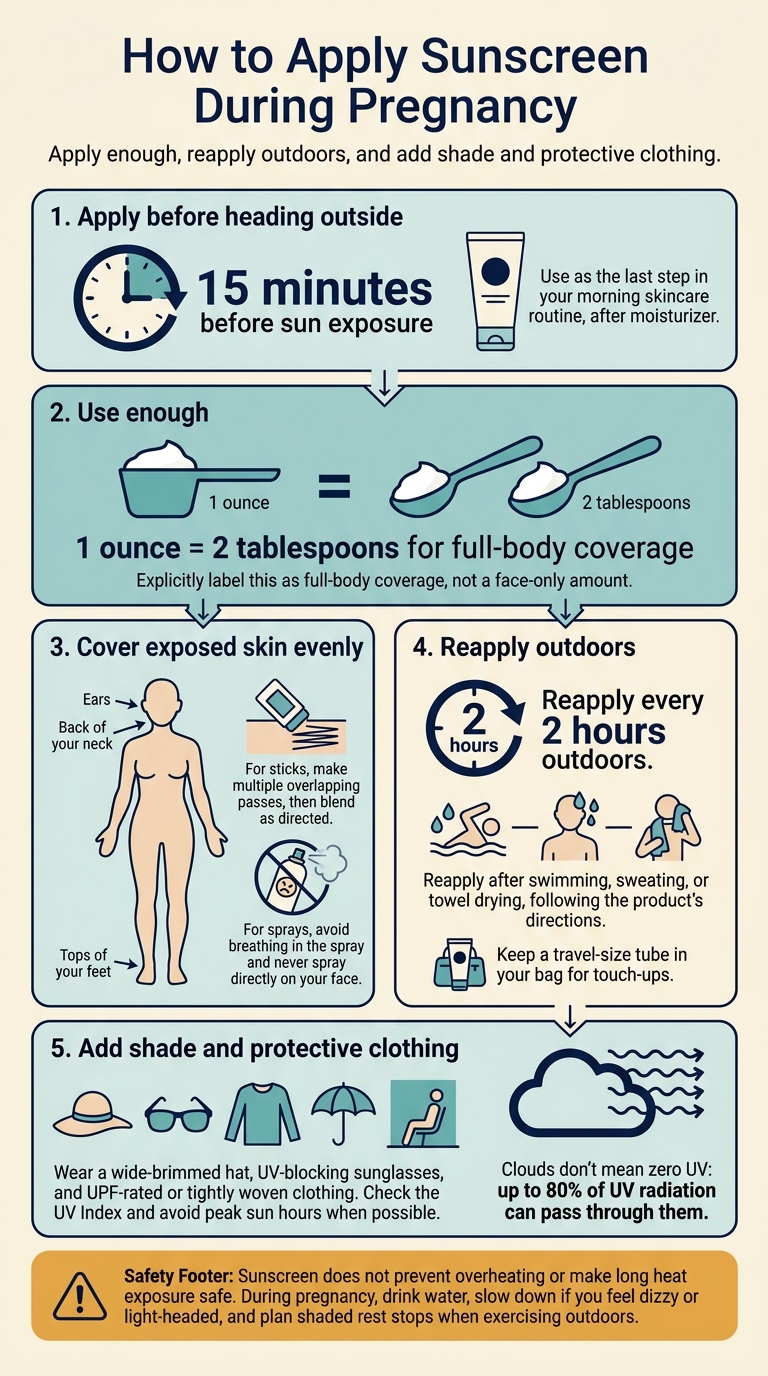
How to Apply Sunscreen During Pregnancy
Once you’ve picked a formula, how you apply it matters just as much as its ingredients.
Apply Enough and Reapply Outdoors
Apply sunscreen 15 minutes before sun exposure, as the last step in your morning skincare routine after moisturizer. Most adults need about 1 ounce, or 2 tablespoons, for full-body coverage. Cover all exposed skin, including your ears, the back of your neck, and the tops of your feet.
Outdoors, reapply every 2 hours and after swimming, sweating, or towel drying, following the product’s directions. Keep a travel-size tube in your pregnancy care package to make touch-ups easier.
Get Even Coverage With Lotions and Sticks
When using a stick, make multiple overlapping passes, then blend as directed. With spray sunscreen, avoid breathing in the spray and never spray it directly on your face.
Sunscreen works best alongside other sun-protection habits.
Use Shade and Protective Clothing
Pair sunscreen with a wide-brimmed hat, UV-blocking sunglasses, and UPF-rated or tightly woven clothing. Check the UV Index and avoid peak sun hours when possible. Clouds aren’t a reason to skip protection: up to 80% of UV radiation can pass through them. Shade reduces exposure, but uncovered skin still needs sunscreen.
Sunscreen does not prevent overheating or make long heat exposure safe. During pregnancy, drink water, slow down if you feel dizzy or light-headed, and plan shaded rest stops when exercising outdoors.
Sun Protection After Delivery
Keep up your daily sun-protection habits as part of your postpartum essentials after delivery. Melasma can linger after birth, and sun exposure can darken it, so sun protection still matters postpartum.
Using Sunscreen While Breastfeeding
While nursing, choose a mineral sunscreen with zinc oxide or titanium dioxide. Keep it off the nipple, areola, and any skin your baby’s mouth may touch.
Ask your dermatologist before using hydroquinone, retinoids, or combination treatments while nursing.
Make Sun Care Part of Your Daily Routine
Keep sunscreen with the items you use each day so it’s easy to apply before leaving home.
For infants under 6 months, use shade, protective clothing, and a wide-brimmed hat. Ask your pediatrician about sunscreen.
Conclusion: Your Sun-Protection Checklist
Keep this checklist handy when shopping for pregnancy essentials or heading outside.
-
Check the label: Look for broad-spectrum SPF 30 or higher, water resistance of 40 or 80 minutes, and the expiration date.
-
Consider mineral filters: Zinc oxide and titanium dioxide are common precautionary choices during pregnancy.
-
Apply generously: Use about 1 ounce (a shot glass) for full-body coverage. Cover all exposed skin, including your ears and toes. Reapply every 2 hours outdoors and after swimming or sweating.
-
Cover up and seek shade: Wear a wide-brimmed hat, sunglasses, and protective clothing. Seek shade from 10 a.m. to 4 p.m.
Using these steps consistently is the simplest way to protect your skin during pregnancy.
FAQs
Should I worry about chemical sunscreen I used before knowing I was pregnant?
If you used chemical sunscreen before you knew you were pregnant, try not to worry. Talk with your OB-GYN or healthcare provider for advice tailored to you and peace of mind.
For future use, experts recommend mineral-based sunscreens with zinc oxide or titanium dioxide. This helps you avoid ingredients such as oxybenzone, which may interfere with hormone function.
Do I need sunscreen indoors during pregnancy?
Yes - wear sunscreen indoors during pregnancy if you get a lot of sunlight through windows, especially if you’re prone to melasma or sensitivity to sunlight. Rumbly recommends using a broad-spectrum mineral sunscreen with SPF 30–50 daily. Choose one with zinc oxide or titanium dioxide, which sit on the skin’s surface rather than being absorbed, to help keep pigmentation, such as the “mask of pregnancy,” from getting worse.
Is SPF makeup enough sun protection during pregnancy?
No, SPF makeup alone generally doesn’t provide enough consistent, broad-spectrum protection against pregnancy-related skin concerns like melasma.
Experts recommend finishing your morning routine with a dedicated broad-spectrum mineral sunscreen with SPF 30 to 50 that contains zinc oxide or titanium dioxide. These filters protect against UV rays at the skin’s surface, providing more reliable protection than makeup alone.
Sending hugs,
rumbly